Chiropractic school takes four years. You come out with a doctorate, a license, and a foundation of clinical knowledge that is genuinely substantial. You know anatomy with a depth that most healthcare providers do not. You understand neurophysiology, biomechanics, radiology, diagnosis. You have adjusted hundreds of spines under supervision before you ever see a patient on your own.
And then you graduate. And if you are paying attention, you realize that what you just earned is a starting point.
The practitioners who develop into exceptional clinicians over a career are not the ones who graduated with the best grades or the most clinical hours. They are the ones who, after leaving school, kept showing up. To seminars, to mentors, to difficult cases that pushed them past what they already knew. The craft does not fully reveal itself in four years. It reveals itself over decades, to people who are still actively studying it.
A license means you are qualified to practice. What happens after licensure determines what kind of practitioner you become. The gap between the minimum and the exceptional is almost entirely built in post-graduate study.
What Chiropractic School Does and Does Not Teach
The core chiropractic curriculum covers the foundations well. Anatomy, physiology, pathology, diagnosis, radiology, adjusting technique -- students get substantial exposure to all of it. What a four-year program cannot do is fully develop the palpatory intelligence that separates a technically adequate adjustment from a precise one. That takes repetition over years, under the eyes of practitioners who have already developed it.
It also cannot expose students to the full range of specialized areas that exist within chiropractic: pediatric and prenatal care, extremity adjusting, cranial work, sports performance, neurology, functional rehabilitation, personal injury documentation. Each of these requires additional post-graduate training to practice at a high level. Chiropractic school gives you the framework. Post-graduate study gives you the depth.
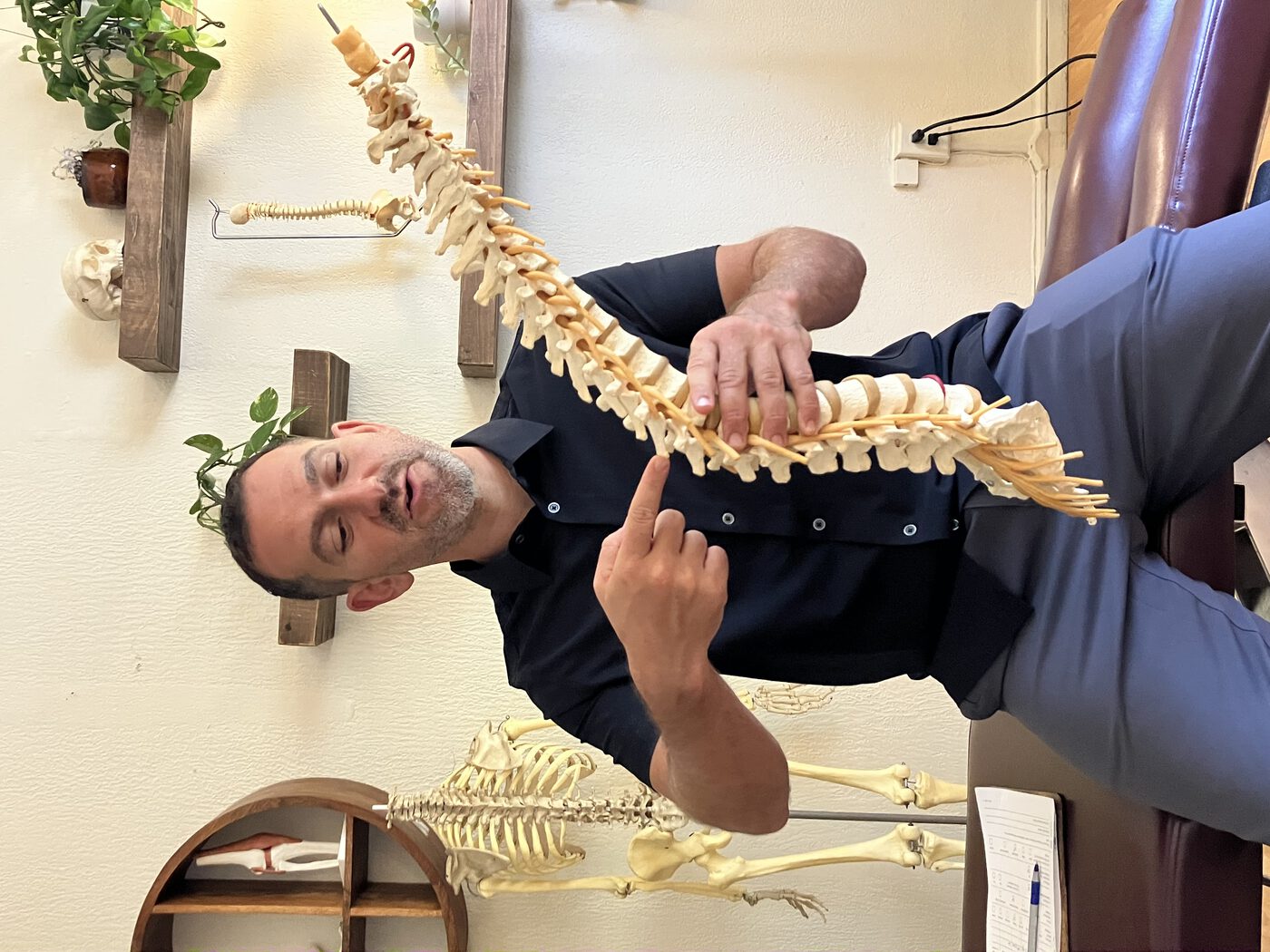
The Mentors Who Shaped Our Practice
Both Dr. Ben and Dr. Irina trained formally at Life West Chiropractic College in the Bay Area, and both have continued their education well beyond licensure. But the most formative learning often happens outside of formal programs -- in rooms with practitioners who have been doing this for thirty or forty years and have developed a level of clinical sensitivity and precision that cannot be put in a textbook.
These are not famous names outside of chiropractic. But within the profession, certain practitioners are known as carrying a depth of clinical understanding that others travel to study with. The lineage matters. Who taught you, and who taught them, shapes what you bring to a patient.
The Strauss and Barge Legacy
Dr. Joseph Strauss and Dr. Fred Barge represent a tradition of chiropractic philosophy that treats the discipline as a complete system of thought -- not just a physical technique. Their work on the innate intelligence of the body, the nature of subluxation, and the relationship between structural integrity and whole-person health forms the philosophical foundation that informs how we think about every patient we see.
Palpatory Intelligence and the Master Clinicians
The palpatory skill to feel what a spine is actually doing -- not just what it looks like on an X-ray or what the patient says hurts -- is developed over years under practitioners who have it. Dr. Ben has studied with clinical mentors who have spent decades refining this sensitivity. It is the kind of learning that requires being in the room, hands on, with someone who can feel what you are missing.
ICPA Post-Graduate Program
Dr. Irina completed a two-year post-graduate program through the International Chiropractic Pediatric Association. This is not a weekend certification -- it is a sustained, rigorous curriculum in the assessment and care of pregnant women, newborns, infants, and children. Webster Technique certification is one component of this training, not the entirety of it.
Movement Science and Advanced Extremity Work
Dr. Ben's background in kinesiology from Temple University, combined with post-graduate training in extremity adjusting and Foundation Training, gives The Shift a clinical depth in the assessment and correction of the full kinetic chain that many chiropractic practices do not have. The spine is not the only thing that subluxates. The shoulder, knee, ankle, and wrist matter too.
The Credentials Behind Our Practice
Post-graduate credentials are not just letters after a name. They represent specific bodies of knowledge, supervised clinical hours, and examinations that test whether a practitioner actually knows what the credential claims they know. Here is the training history behind The Shift.
Dr. Ben -- B.S. Kinesiology, Temple University
Foundation in movement science, biomechanics, and exercise physiology before chiropractic school. Shapes the movement-based lens he brings to every clinical assessment.
Dr. Ben -- Doctor of Chiropractic, Life West Chiropractic College
Four-year doctorate. Extensive clinical training in the Bay Area, including supervised hours across multiple teaching clinics. Life West has a strong emphasis on the philosophy of chiropractic alongside the technique.
Dr. Ben -- Certificate in Massage Therapy
Formal training in soft tissue work prior to and alongside chiropractic practice. Informs the integrated approach to muscle, fascia, and joint treatment at The Shift.
Dr. Irina -- Doctor of Chiropractic, Life West Chiropractic College
Came to chiropractic from a social work background after personal experience with chiropractic care for injuries from surfing and dancing. Brought a whole-person, trauma-informed lens to the clinical training from the start.
Dr. Ben -- CCWP (Post-Graduate Certification in Chiropractic Wellness Care)
Advanced post-graduate certification in wellness-based chiropractic practice -- prevention, maintenance care, and the integration of chiropractic into a complete lifestyle health model.
Dr. Ben -- Foundation Training Certification
Certification in Foundation Training, a movement system developed by Dr. Eric Goodman targeting posterior chain strength and posture correction. Integrated into rehabilitation recommendations for many patients.
Dr. Irina -- Webster Technique Certification (ICPA)
Webster Technique is a specific chiropractic analysis and adjustment protocol for the sacrum and pelvis in pregnant women, facilitating optimal positioning for mother and baby. ICPA certification requires both coursework and clinical application hours.
Dr. Irina -- ICPA Two-Year Post-Graduate Pediatric Program
Comprehensive post-graduate training through the International Chiropractic Pediatric Association covering prenatal, newborn, infant, and pediatric chiropractic assessment and care. One of the most rigorous post-graduate tracks available in the profession.
Dr. Ben -- Personal Injury Expert Witness (200+ depositions, 50+ court testimonies)
Expertise in forensic-level clinical documentation and expert witness testimony in personal injury litigation. This is not a credential in the traditional sense -- it is a body of experience earned through cases, depositions, and cross-examination that sharpens clinical documentation standards to a level most practitioners never reach.
"The most important thing I learned after school was that what I knew was a framework, not a finished building. The best clinical minds I have met are the ones who are still genuinely curious -- still finding things that surprise them, still being humbled by what a body can do that they did not expect."
-- Dr. Ben Glass, D.C.What to Look for When Choosing a Chiropractor
Most people choose a chiropractor the way they choose most things: based on proximity, reviews, or a recommendation from a friend. Those are reasonable starting points. But if you want to find a practitioner who will actually serve you at a high level over time, there are more useful questions to ask.
Post-graduate training
What have they studied beyond their chiropractic license? Specializations, certifications, and continuing education that goes beyond the state minimum tells you something real about clinical investment.
Mentorship lineage
Who did they train with after school? A practitioner who has studied under experienced clinicians brings a depth that school alone does not produce. Ask about their mentors.
Assessment before treatment
Does the practitioner assess your spine thoroughly before adjusting? A full first-visit assessment -- not a brief palpation and immediate treatment -- is a marker of clinical seriousness.
Multiple techniques
Does the practitioner adapt technique to the patient, or does everyone get the same thing? Practitioners who have invested in post-graduate training typically have a broader toolset.
Honest referrals
Will they tell you when chiropractic is not the right fit? A practitioner willing to refer out when appropriate demonstrates clinical integrity over patient retention.
Clear communication
Do they explain what they found and why they are recommending what they are recommending? Informed patients make better decisions and have better outcomes. Good practitioners know this.
At The Shift, we meet all six of these criteria. And we are still studying. That combination -- high standards already met, active pursuit of higher ones -- is what we believe patients deserve.
See the difference post-graduate training makes in the room. New patients welcome -- comprehensive first visit, no obligation.
Book Your First VisitAdd video here -- Dr. Ben on post-graduate training and why it matters
Personal and direct -- talk about specific mentors and what they taught you
Frequently Asked Questions
All licensed chiropractors in California have completed a four-year doctorate program and passed national and state board examinations. That baseline is consistent. What varies enormously is what happens after licensure -- post-graduate specializations, mentorship, continuing education, and the development of clinical skills that only come from years of deliberate practice under experienced guidance. Two chiropractors with the same license can have very different clinical capabilities based on what they have invested in since graduating.
The CCWP (Chiropractic Wellness Practitioner) is a post-graduate certification from the International Chiropractic Association focused on wellness-based chiropractic care -- proactive, maintenance-oriented care rather than purely symptom-based treatment. Practitioners with this certification have demonstrated knowledge in nutrition, lifestyle factors, and the integration of chiropractic into a comprehensive wellness model. For patients, it means your chiropractor thinks about your long-term health outcomes, not just the immediate presenting complaint.
Webster Technique is a specific chiropractic analysis and adjustment protocol developed by Dr. Larry Webster for the sacrum and pelvis in pregnant women. The technique addresses sacral subluxation and the associated soft tissue imbalances that can restrict normal uterine function and fetal positioning. It is not a technique for turning breech babies directly -- it is a technique for restoring pelvic and sacral balance so the uterus can function optimally. ICPA-certified Webster practitioners have completed coursework and supervised clinical application in this technique specifically.
Chiropractic philosophy -- the underlying framework for how the body works and what health means -- shapes how a practitioner approaches every clinical decision. A practitioner grounded in the philosophical tradition of Strauss, Barge, and others who saw chiropractic as a complete system of health rather than just a back pain treatment will approach patients differently from one who treats it purely as a mechanical intervention. The philosophy is not mystical -- it is a coherent framework for understanding the body's intelligence and the role of structural integrity in overall function.
Yes -- Dr. Ben Glass serves on the Board of Regents at Sherman College of Chiropractic, one of the profession's most philosophically grounded institutions. This involvement keeps him connected to the broader conversations in chiropractic education, philosophy, and the future of the profession -- and brings that perspective directly into how The Shift is run and how we develop as practitioners.
Train with Someone Who Never Stopped Training
Schedule your first visit at The Shift Chiropractic -- 435 8th Street Suite 203, downtown Oakland. Two blocks from 12th Street BART. Same-day appointments available.
Book Your First Visit